


Target logo

Driving a data platform roadmap pivot to grow adoption

Pivoting a stalled enterprise data platform roadmap from widget creation to data discovery

Executive summary

Target's data visualization & reporting platform was being built for the 3% of users who created dashboards while 97% — the analysts and PMs consuming them — couldn't find datasets they needed, wasting $52M annually in lost productivity. I joined to diagnose the gap and realized the roadmap had been pointed at the wrong problem entirely.

I drove a strategic enterprise-level pivot from widget creation to data discovery and restructured the team into a dual-track model that separated leadership vision-setting from cross-functional execution. Along the way I coached a senior designer through the climb to team lead — tightening the two-way feedback loop with her so I could dial my involvement to match where she was in the climb. This approach enabled her to run with & evolve the vision across 3 product teams.

Project role

UX Manager, Design & Research

Time frame

2021 - 2022

Company size

415,000

Leadership Scope

4

Company stage

Fortune 50 Enterprise

Industry

Data Science

Experience Design
Mentoring
Strategic Partnership
User Research

$27M

Annual Cost Savings

175%

Onboarding Improvement

530%

Time-to-Insight Reduction

300%

Of Exposure Hours Goal

Problem & Stakes

I pushed back on a roadmap pointed at 3% of our users

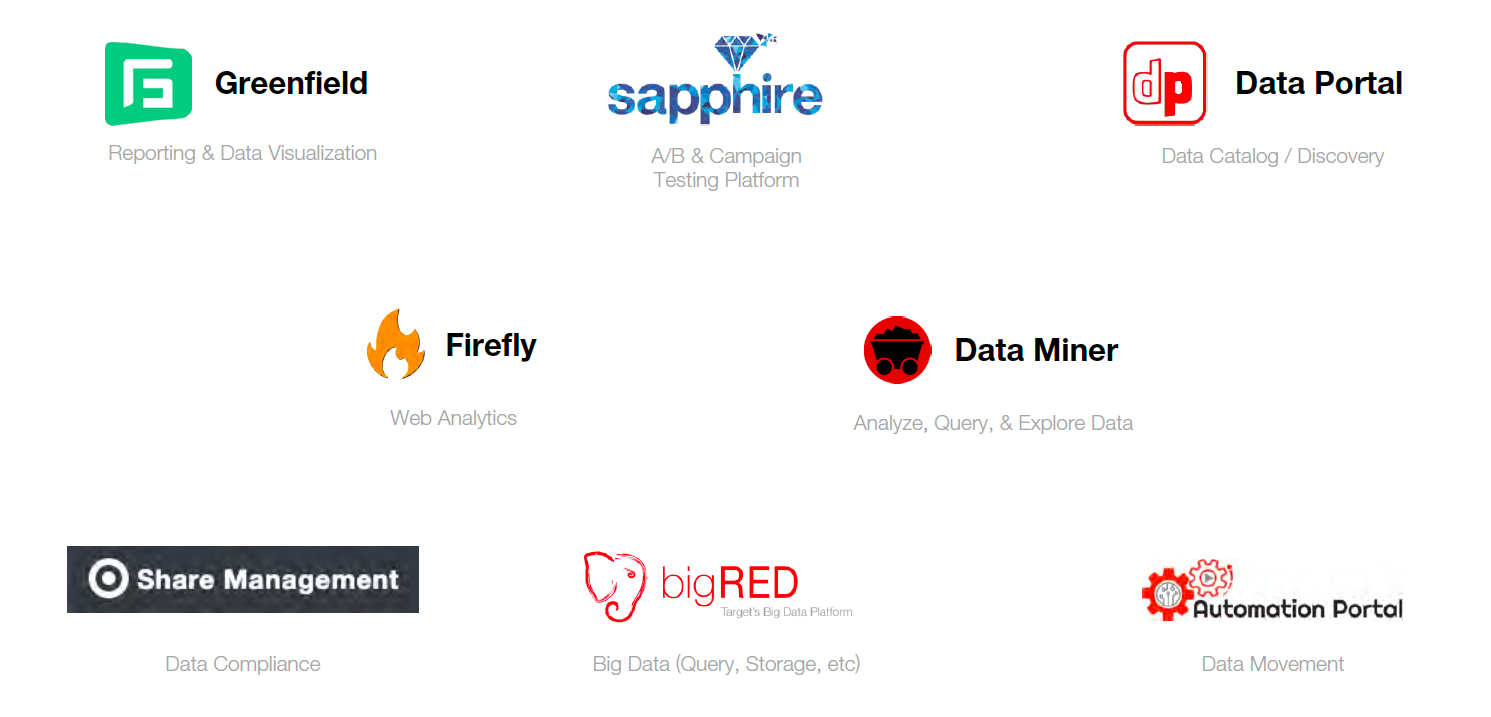
At Target I founded, built, and managed the UX team responsible for a suite of 8 internal Data Science products used by 500,000+ team members and vendors. Greenfield, our reporting and data visualization tool, had the largest current and potential user base of the 8. It was where employees and vendors came to consume the data in Target's millions of data tables and use it to make decisions.

The 8 Data Science products: Greenfield (Reporting & Data Visualization), Sapphire (A/B & Campaign Testing Platform), Data Portal (Data Catalog / Discovery), Firefly (Web Analytics), Data Miner (Analyze, Query, & Explore Data), Share Management (Data Compliance), bigRED (Big Data), and Automation Portal (Data Movement).
The 8 Data Science products my team supported. Greenfield was where most of Target went to consume data.

Data Scientists, Analysts, Product Owners, Merchandisers, and many other kinds of team members used a variety of reporting and visualization tools, and many of those were 3rd-party tools the company spent tens of millions of dollars each year to keep. Greenfield's mission was to become the data visualization and reporting hub for all of Target's data, so those other tools would no longer be needed and we'd control the systems we used to do business.

We need to make it easier for people to create dashboard cards.
Rob Koste
Rob KosteDirector of Product, Data Sciences

Looking at the numbers before saying yes

About 9 months into my time at Target, Rob came to me wanting to prioritize making it easier to build cards and dashboards. Card creation was a real pain point, and I could have said yes. But when I paired our usage numbers with contextual inquiry results, 3 things stood out:

Only 3% of users were builders

Some of that was the unintuitive, frustrating creation experience. But hundreds of thousands of users just wanted to consume data. We said we wanted to be THE reporting and visualization platform, and we weren't solving the real pain of the biggest share of our user base.
$52M a year in preventable wasted productivity

Beginner and mid-level users couldn't easily use Greenfield, so they leaned on Analysts and Product Owners to find data sets, reports, and dashboards for them. Our Analysts and POs were spending more than half their time on that. There were day-long training classes, a Slack channel dedicated to finding data, and a team of trainers standing in for the UI.

85% of analyst teams failed a 1-week test

We ran a hackathon-style contest: 35 teams of mid-level analysts, 1 data-related business question, 1 week to answer it. Only 15% did. If teams of analysts couldn't do it, the average business person with less technical acumen didn't have a prayer.

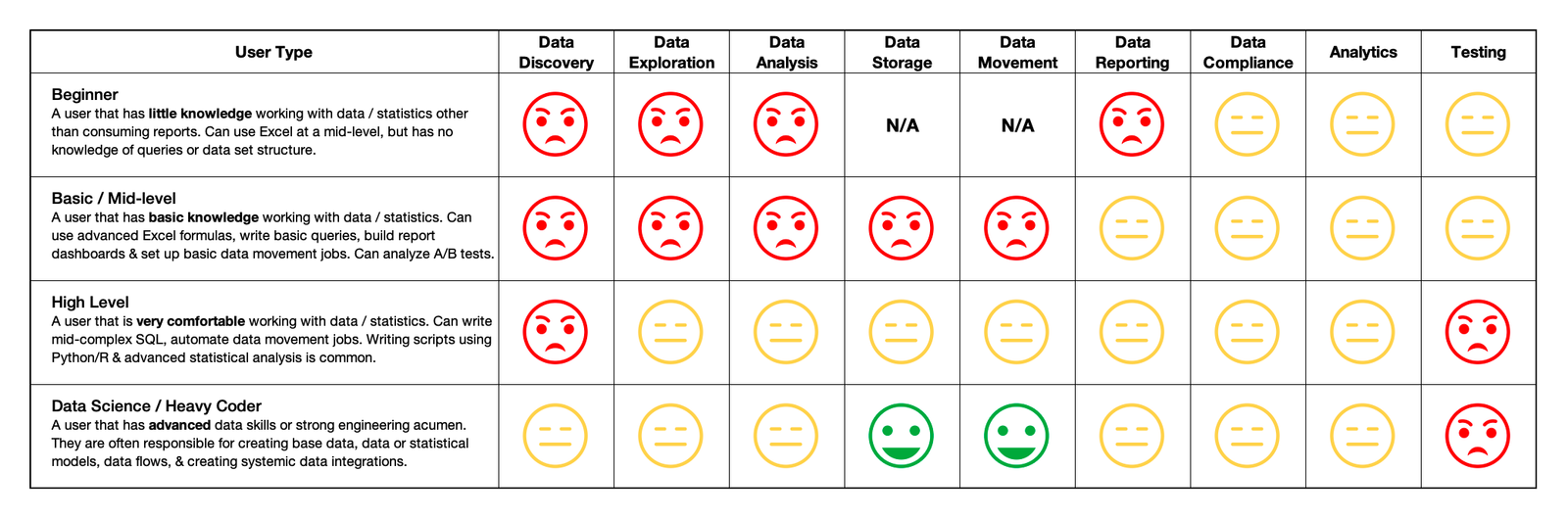
Matrix of 4 user tiers (Beginner, Basic / Mid-level, High Level, Data Science / Heavy Coder) against 9 stages of the data journey (Data Discovery, Exploration, Analysis, Storage, Movement, Reporting, Compliance, Analytics, Testing), scored with red, yellow, and green faces. Beginner and mid-level rows are mostly red; Data Discovery is red for 3 of the 4 tiers.
How each user tier experienced our tools across the data journey. Card builders (bottom rows) were served far better than the beginner and mid-level users who made up the majority. Data Discovery was red for 3 of the 4 tiers.

The users with the worst experience were also our biggest active and potential user base, and the vast majority of the people making billion-dollar decisions were among the 97%. The problem was much deeper than a UI redesign of the card builder. If we didn't solve data discovery first, a better card builder wasn't going to move our mission or our OKRs, and plenty of the builder's own pain traced back to discovery and even the data model underneath it.

The task

Rob really wanted to do this right, so he accepted my push back. After some deliberation with our Engineering Director partner, Jason, the 3 of us agreed to pivot the roadmap to 3 data discovery objectives:

  1. 1.Increase adoption by those less familiar with data science.
  2. 2.Reduce time spent on helping others find data sets.
  3. 3.Reduce “time to insights” for answering business questions.

Strategic Approach

Redirecting the roadmap & betting on a designer ready to prove herself

The pivot answered what to build. It didn't answer who would lead it, or how an engineering-first team would work with UX for the first time.

Follow the data. Bet on the person. Put guard rails around the autonomy.

Follow the data to the 97%

Rob's ask was a real pain point from a strong partner, and I could have staffed it. Instead I had the team pull usage data and pair it with contextual inquiry. 3% builders, $52M a year in wasted productivity, and 85% of analyst teams failing a 1-week test made the case: fix discovery upstream first. It was a prerequisite to solving the card builder anyway.

Give a Senior a Lead-level problem

The Lead I planned to put on this left the team just as a new Senior Designer joined (I'll call her Kim here). Kim was single-mindedly seeking a promotion to Lead, and her previous managers didn't think she was ready. She disagreed, and she had been a data analyst before switching into UX. So I gave her the Greenfield problem, 3 clear asks, and left the how to her.

Put guard rails around the autonomy

The Greenfield team was engineering-first and had never really worked with UX. When team-level working agreements didn't hold, I moved the alignment up a level: roles and responsibilities agreed with the Product and Engineering Directors, and a resourcing model that matched the work instead of stretching 1 designer across 2 teams.

Execution & Alignment

Coaching through a stalled partnership without taking the work back

The research landed. The partnership didn't. What I did next hurt before it helped.

Setting Kim up with 3 asks & a lot of room

I wouldn't normally be intricately involved in decision making with a Lead, so I gave Kim a lot of autonomy. I set the objectives and goals for the project with Rob and Jason, then stayed connected through a weekly 1:1, our team Design Critique, and periodic check-ins with the cross-functional leadership group. Outside of those, how she approached the objectives was up to her. As a leadership group we wanted to see what she and the team could come up with.

Run a multi-method research project

Understand where people were getting hung up on their data discovery journey across Greenfield and the other data tools, and establish user exposure hours as a regular part of this team's process. It had none.

Develop & pitch an experience vision

Turn the research into a vision of what data discovery at Target could look like, pitch it, and partner with the Product Owners of Greenfield and Data Portal (our data catalog) on a proposal for the first couple of phases to get there.

Improve the UX partnership

The Greenfield team was historically very engineering-driven and wasn't used to working with UX. Strengthen the partnerships and establish a working agreement with her partners going forward. All of it would be good evidence for a promotion case.

Uncovering that no one could find what already existed

The multi-method research project went very well. Research is one of Kim's biggest strengths (she's probably one of the best designer-researchers at Target), and she uncovered some very crucial insights:

  • Almost no one could find dashboards, cards, or reports that already existed without someone sending them a bookmark.
  • Data in Greenfield cards didn't match the same datasets surfaced elsewhere. People burned time comparing and contrasting sources, and some avoided Greenfield altogether.
  • Data Portal only worked if you already knew the exact name of a data table. Search was being used to pull up a data set, not to discover one. In 1 example, “cart_size” returned 152 unique results, and telling them apart was extremely difficult and time consuming.

The data inaccuracy and trust concerns were a big enough problem that solving them became a Data Science org-wide (12 products) “Big Rock” OKR. Kim's research was instrumental in uncovering and pitching that.

Falling behind while the partnership stalled

The partnership was a different story. Engineers simultaneously avoided looping Kim into the big decisions and looped her into too much. They pulled her into small UI decisions and she wanted to go deep on everything, which frustrated everyone involved. An associate product manager was trying to control the UX backlog, make the final UX calls, and micromanage her work. Kim is also a very blunt person and didn't approach some of those situations with the tact they needed.

We were also getting behind schedule. Great work was happening, but we didn't have anything to show for the weeks we'd put in. Rob told me he supported the approach, but we needed to find a way to move things along. A lot was being lost in inefficiency and needless debates.

So I got more involved: team meetings, a UX Sprint Planning meeting, frequent Design Reviews with partners. We got some wins out of it (we gained some autonomy over our own backlog). But without realizing it, I had started to smother Kim and undermine her decision-making in front of her team. I was hurting, not helping.

Getting told I was too in the details

Radical Candor is something I really believe in. I give and seek feedback regularly and do the work to get to know and invest in each person on my team. I had set that environment up with Kim early on, and it made all the difference on this project.

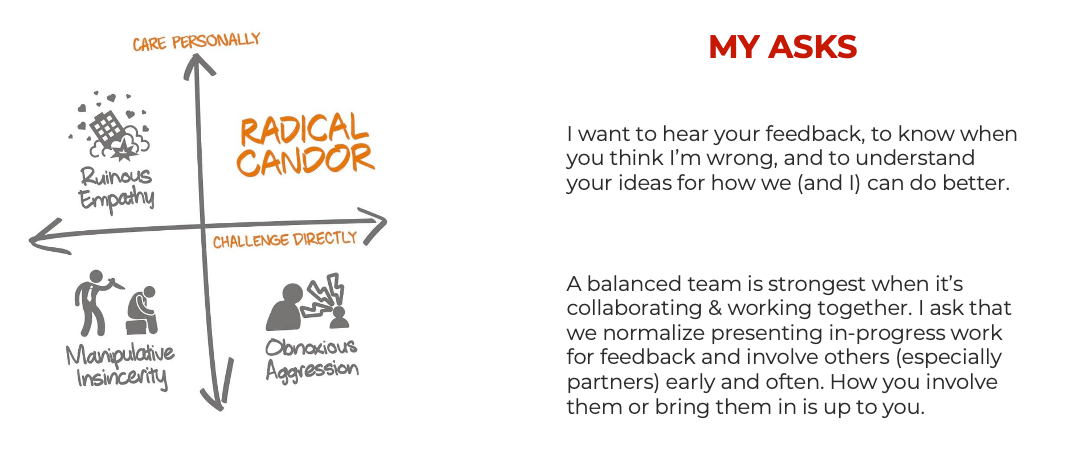
Left: the Radical Candor quadrant (Care Personally vs. Challenge Directly). Right, under 'My asks': 'I want to hear your feedback, to know when you think I'm wrong, and to understand your ideas for how we (and I) can do better,' and 'A balanced team is strongest when it's collaborating & working together. I ask that we normalize presenting in-progress work for feedback and involve others (especially partners) early and often. How you involve them or bring them in is up to you.'
The 2 asks I make of every team member. The first one is what made the next conversation possible.

In one of our 1:1s, Kim told me I was too in the details. I had overcorrected in an effort to help, and giving her feedback in front of her team was devaluing her as the UX subject matter expert on it. She was right. To keep supporting her growth without micromanaging, I changed 3 things:

I pulled out of her balanced team meetings

I let her handle her team discussions alone. I still gave her ideas, but I stopped trying to solve the problems for her.

I moved my feedback into pair design sessions

1:1 working sessions where I could react to the work directly. That let her show up to her Product and Engineering lead partners as the expert.

I named whether I was giving “feedback” or “direction”

When your manager gives you feedback it isn't always clear whether it's “consider this” or “go do this.” I over-index on consider (about 90% of the time) but hadn't said so. I started calling out which one I was giving, and asked her to ask whenever it wasn't clear.

Aligning Product, Engineering & UX at the leadership level

The team-level working agreements weren't working, and I still wanted Kim to have her autonomy. So I took the alignment up a level. I approached Rob and Jason to agree on roles, responsibilities, and a collaboration model for the product triad. I facilitated the discussions and created the visualization. We focused on what each role owned individually, where the roles overlapped, and what everyone owned collectively. Then we shared our expectations down to the team and left the specifics of the how to them. We didn't want to be prescriptive, but we did need guard rails around the autonomy so partnership in our space actually worked.

The other problem was structural. Kim had been trying to work in an embedded model, and there were 2 Greenfield teams and only 1 Kim. She was pulled in too many directions and couldn't focus the time the most important work needed. Rob was product-managing 1 of the teams himself while a more junior product manager covered the other, and there wasn't good scope over which team did what. I pitched Rob and Jason on restructuring into a dual-track resourcing model, with my UX Director's support. Leadership would set the vision and priorities, a Discovery Team would work the problem, and the dev teams would refine and build their part.

Outcomes & Downstream Impact

Driving business & culture results across 3 teams

The results were felt quickly, and the culture changes outlasted the project.

$27M

Annual Cost Savings

175%

Onboarding Improvement

530%

Time-to-Insight Reduction

300%

Of Exposure Hours Goal

Analysts' and Data Product Managers' time spent helping users find data sets and widgets dropped drastically almost immediately. That's where the $27M in reduced wasted productivity costs (annually, against the $52M we had sized) came from. Greenfield onboarding time decreased by 175%, time from question to data-informed decision dropped 530%, and the Greenfield teams hit 300% of their customer exposure hours goal.

What changed in how the org worked

The business numbers were the point of the pivot. These are the changes that made them stick:

  • Kim's work with the Discovery Team turned into a Data Science org-wide strategic investment in Data Discovery & Trust.
  • Research became a regular part of 3 teams' process, not just 1, with cross-functional representation in 100% of sessions.
  • Goal setting and strategic planning became unified across the teams instead of separate, and shared outcome-focused initiatives were established Data Science wide.
  • Product and Engineering begged for more UX resources and helped me build the business case to secure them.

Before

A roadmap pointed at the 3% who build cards. 1 designer stretched across 2 engineering-first teams with no working agreement. Analysts and POs spending more than half their time helping people find data.

After

A roadmap pointed at discovery for the 97%. Product, Engineering, and UX aligned on roles at the leadership level, a dual-track model under it, research in 3 teams' process, and Product and Engineering asking for more UX.

Reflections

Reflections on the work

The accomplishment I'm most proud of is how much Kim grew as a designer and as a partner. I was grateful for the experience too, because I learned a lot about coaching without micromanaging along the way.

What made a difference

  • Question the ask before you staff it. The card builder was a real pain point and the request came from a strong partner. Pulling the usage data and the contextual inquiry results before saying yes is what turned a UI project into a $27M pivot, and it's what let Rob accept the push back.
  • The candor groundwork paid for itself. I couldn't have received “you're too in the details” if I hadn't spent months asking Kim for exactly that kind of feedback. The 1:1 that corrected my course only happened because the environment for it already existed.
  • Guard rails at the leadership level protect autonomy at the team level. When working agreements failed on the team, the fix wasn't more of me in the room. It was aligning Rob, Jason, and me on roles and a resourcing model, then handing the how back to the team.

What I'd do differently

  • I'd get out of the weeds sooner, and say “feedback” or “direction” from day 1. When the partnership stalled I defaulted to being more present, and it took Kim telling me to see that I was undermining the person I was trying to develop. Next time I'd move my involvement into pair design sessions from the start, and I'd be explicit about which kind of input I'm giving before it ever becomes a question.

Manage how this site uses cookies and analytics. See the Privacy Policy for full detail.

Strictly necessary

A small first-party cookie that remembers you've dismissed the cookie banner. Required for the site to remember your preferences.

Analytics

Microsoft Clarity provides anonymous session replay and heatmaps so I can see how the site is used and improve it. Contact-form inputs are masked. Cloudflare Web Analytics (cookieless, aggregate) is always on and not affected by this toggle.