
No shared way to size the work
UX, Product, and Engineering had no common language for scoping design — so every estimate started from zero.

Maturing design operations, throughput, and quality for an org of 19 designers across 5 product domains
Executive summary
Xometry brought me in to scale UX through a period of rapid growth — maturing systems, accelerating throughput, and raising the quality bar across a design organization of 19 spanning 5 product domains. I diagnosed a process gap: no capacity planning framework, scattered tools fragmenting workflow visibility, and a critique culture stuck on subjective feedback.
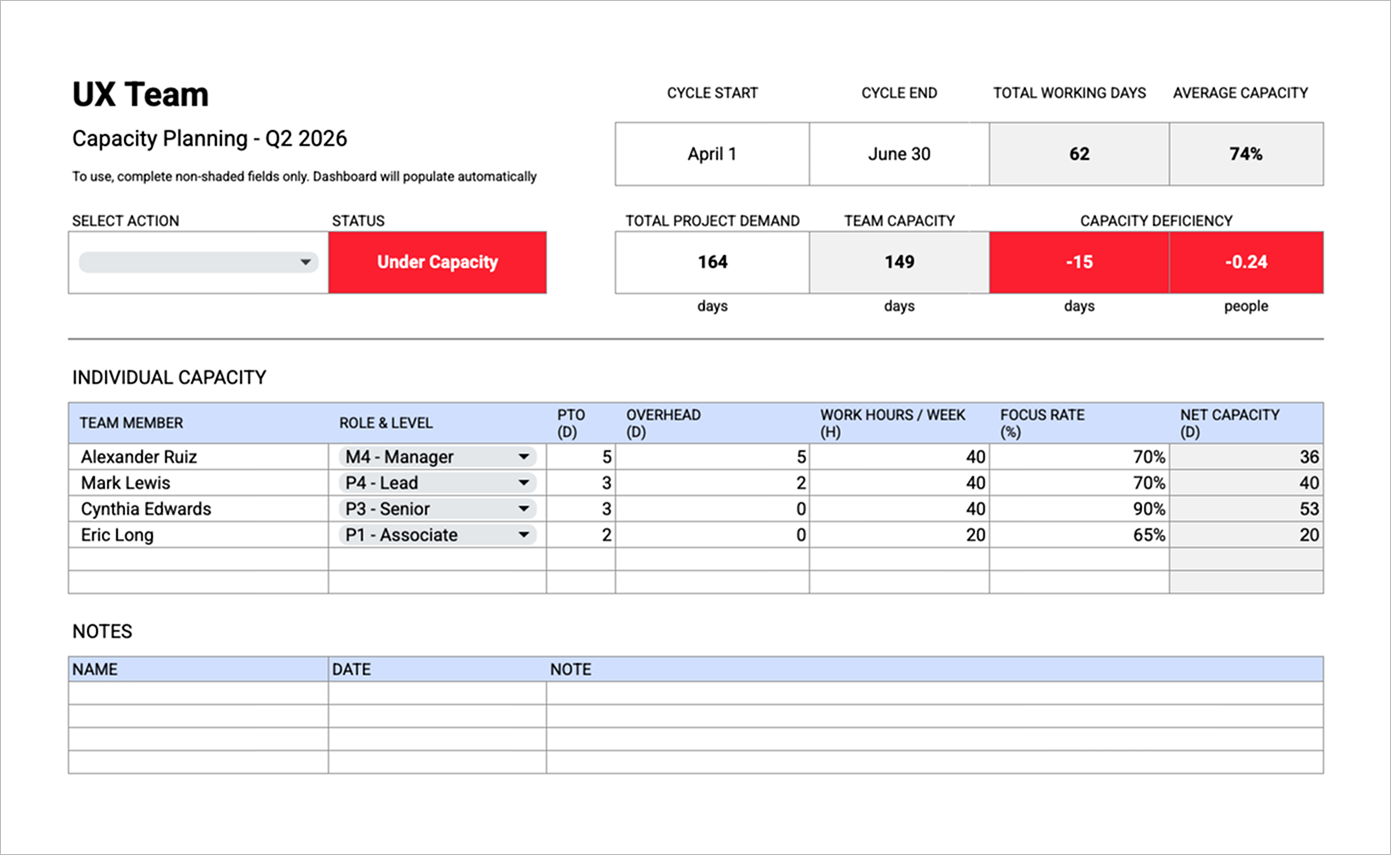
I shipped a UX Effort Framework that delivered capacity planning for the first time, migrated UX workflows to Jira to create a single source of truth across departments, redesigned critiques to align on outcomes instead of opinions, and introduced AI-first design tooling that compounded what every designer could produce.
Project role
Sr. UX Manager, Design Ops
Time frame
11/2024 – 6/2026
Company size
1,200
Leadership Scope
19 across 5 domains
Company stage
Scale-up
Industry
Manufacturing
98%
Quarterly Commitments Delivered
80%
Unplanned Work Reduction
25%
Throughput Lift
35%
Onboarding Reduction
5
Flexible UX Squads
Problem & Stakes
Xometry's design org had grown to 19 designers across 5 product domains when I joined as Sr. UX Manager for Design Ops — big enough to have real leverage, but missing the infrastructure to use it. UX wasn't in the room when the roadmap got committed; its capacity was whatever time was left after Engineering scoped its work — which guarantees the same result every quarter: an over-committed team, burned-out designers, and rushed work.
This was never just a UX problem. When UX gets whatever time is left over, the entire team — not just design — is set up to fail.
Strategic Approach
If UX can't be planned for, it can't be invested in.
The instinct in a high-growth org is to accelerate. But you can't accelerate work that isn't visible, and you can't scale capacity that nobody has measured. Before I could make UX faster, I had to make it legible — to the design team, to product partners, and to the engineering squads we shipped with. Three interdependent systems, built in sequence.
Outcomes & Downstream Impact
The org behaves differently now. Product and Engineering now plan UX work the way they plan engineering work.The shared sizing language, tracked capacity, and commitments enable UX work to impact quarterly planning commitments instead of backing into them mid-sprint.
98%
Quarterly commitments delivered
80%
Unplanned work reduction
25%
Throughput lift
35%
Onboarding reduction
5
Flexible UX squads
Before
UX capacity backed into from whatever time engineering left over. No shared language for sizing work. Work tracked in spreadsheets and Slack. One 20-person critique mixing 4 purposes.
After
Capacity measured and committed in a 6-step quarterly cycle. Work sized with the UX Effort Framework and tracked in Jira. 3 cross-domain critique groups on a structured rotation, feedback anchored on objectives.
"I've worked at a lot of places, but I've never seen UX work taken into account in quarterly planning. This is a huge unlock. I was skeptical at first, but Jeremy made it happen."


Partners used to commit roadmaps without knowing what UX could take on. Now they size the work with us up front and commit against real capacity, and 98% of those commitments deliver, up 30%. New mid-quarter asks get a simple question: what should come off the list to make room? Unplanned additions are down 80%.

Designers used to make mockups for everything, including decisions that were already made. Now a low-risk request is a quick conversation about the right pattern, and the deep work goes to the projects where design actually changes the outcome. New designers feel it too. With a documented process and a critique rotation to plug into, they onboard 35% faster.

The business gets 25% more design work out of every quarter, and not because anyone works harder. Effort finally matches the risk of each project. Just as important for the long run: none of it depends on me. The planning cycle, the rotations, and the frameworks kept running after I stopped driving them.
Reflections
Operations work is a slow payoff. Nobody thanks you for a capacity model the week you ship it. The thanks comes later, when a designer gets a realistic quarter instead of a burnout quarter because we had the data to push back, or when a critique sends someone away with feedback they can actually use. 3 key takeaways.
WHAT WAS REITERATED
WHAT I'D DO DIFFERENTLY